We start from the public record.
Every ship over 5,000 GT calling at EU ports is listed in a register EMSA publishes under the EU emissions register every year. We load all 17,386 of them, so you type nothing.
EMSA THETIS-MRV · verified emissionsFind what carbon costs each ship, see why, and see what would cut it.
EU ETS, FuelEU and your CII rating, from emissions already on the public record.
The ship decision report answers the six questions owners ask first, in euros, with how sure each figure is.
The pilot: we redo the report on your noon reports and your verifier’s figures, and reconcile every difference. One ship, fee agreed on a short call. How we check our figures
The tools ship managers reach for first, in the order this year’s deadlines ask for them.
Every owner’s MOHA on one board: figures through the year, funding, sign-offs and the surrender.
See itWhat your fleet must buy for 2026, how it compares with its peers, and a plan auction by auction.
Plan your buyingType a name or IMO number: the carbon bill of any ship, why it is what it is, and what would cut it.
Check a shipEach ship’s compliance balance, the penalty it avoids, and the partners it could pool with.
Find pool partners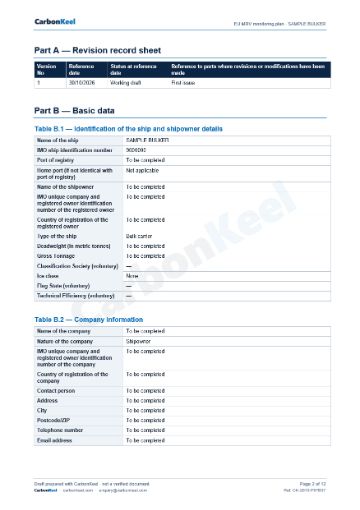
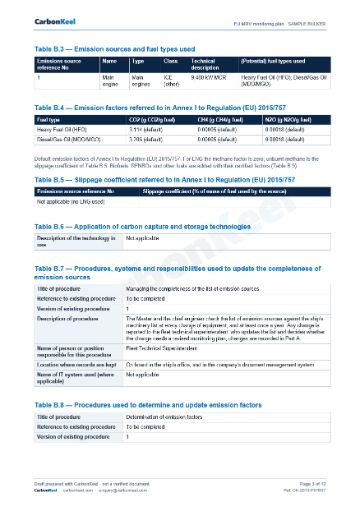
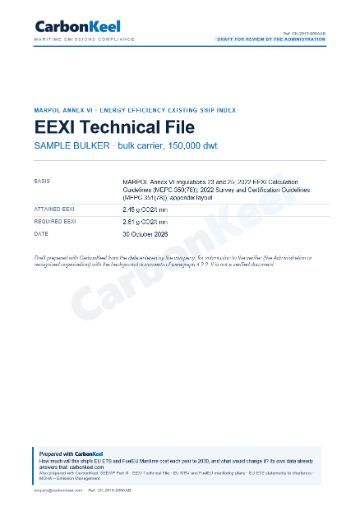
MRV and FuelEU monitoring plans, the EEXI Technical File and the allowance statement to charterers.
Draft a documentThe rating year by year as the limits tighten, and the plan that keeps it out of D and E.
Check the ratingSeveral ships side by side with a report to share, and every deadline in your own calendar.
Open my fleetWhat each regulation costs a ship in euros, from the public record, and what would move it.
A name or an IMO number. That is all we ask for.
ETS, FuelEU and the CII rating, added up in euros.
See which lever moves it most, and how the limit tightens.
The instant check uses verified emissions published a year late: a fair start, not what you owe today.
A year’s verified emissions are made public by 30 June of the following year. Until then, this year’s exposure does not appear anywhere.
2026 is the first year at 100% of EU emissions, with methane and nitrous oxide counted, and the UK ETS covers shipping from 1 July 2026. Last year’s filing understates this year’s bill.
Fuel mix, speed, routes, charters and the ships you bought or sold since the last filing are not in the register, and the public record gives only a fuel total, from which the mix has to be inferred.
Want the analysis for this year? That is the part we do with you: your noon reports and bunker delivery notes, this year’s rules, your pool and charter terms, turned into the position you will actually settle.
A mid-size ship can carry a six-figure carbon bill a year. Here is one, from problem to action.
100% of EU-scope emissions from 2026, and methane and nitrous oxide now count too.
Heavy fuel oil sits above the FuelEU limit, so a charge builds all year.
The CII limit tightens every year: a ship that does nothing falls a band every few years.
| Change | Carbon cost | Fuel cost | Net a year | Time at sea | CII 2025 |
|---|---|---|---|---|---|
| Sail 10% slower | −€88k | −€379k | −€467k | +11% | E (5.31) |
| Hull and propeller cleaning, trim4% and 1.5% less main-engine fuel | −€27k | −€116k | −€143k | none | E (5.99) |
| 20% certified biofuel | −€228k | +€780k | +€552k | none | D (5.03) |
| 10% slower and 20% biofuel | −€282k | +€281k | about €0 | +11% | C (4.25) |
Public data in, the rulebooks applied, checked against your verifier, out as euros.
Every ship over 5,000 GT calling at EU ports is listed in a register EMSA publishes under the EU emissions register every year. We load all 17,386 of them, so you type nothing.
EMSA THETIS-MRV · verified emissionsEU ETS, UK ETS, FuelEU Maritime and the IMO’s CII and EEXI, each coded from the regulation text. Plain calculations you can check, with every factor cited.
IMO resolutions · EU regulationsThe bill uses the EU ETS figure your verifier reported for the ship, so the starting point is the number your company will be held to.
Measured, not promisedEuros, a rating, and the lever that moves it. A public-data estimate until you send your own data; then a customer-data calculation, prepared for review against your verifier’s figures.
Open the worksheet behind every figureRanked the way we would work through them: money first, design checks last.
Allowances you surrender. From 2026 it is 100% of EU-scope emissions, methane and nitrous oxide included.
How far your fuel’s greenhouse-gas intensity sits above the limit, and what the shortfall is charged at.
An A to E grade against a limit that drops each year. Three years at D, or one at E, needs a corrective plan.
A one-off design check most ships cleared in 2023. It matters again for newbuildings, conversions and power-limit changes.
Paste a list of IMO numbers. Get one total, a ranking of your ships, and a drill-down into each.
A compliance calendar for Outlook or Google, and a full worksheet your verifier can follow.
Five things we are built to do well, and can show you.
All 17,386 ships are already loaded. Type a name and the answer is on screen.
No upload, no accountEvery figure opens a full worksheet, each factor tied to a named regulation.
Built for your verifierAnything rebuilt from public data is marked as an estimate, and shows how it compares with the verifier.
About 2 in 3 ships match to the tonneETS, UK ETS, FuelEU and CII added up on one screen, not four spreadsheets.
In euros, for any ship trading into EuropeNothing to upload to start. No advertising trackers, and no cookies except the sign-in cookie of your account.
Ship results are not search-indexedWhat each owner’s MOHA owes, has funded and signed off: admin, performance and finance on one screen.
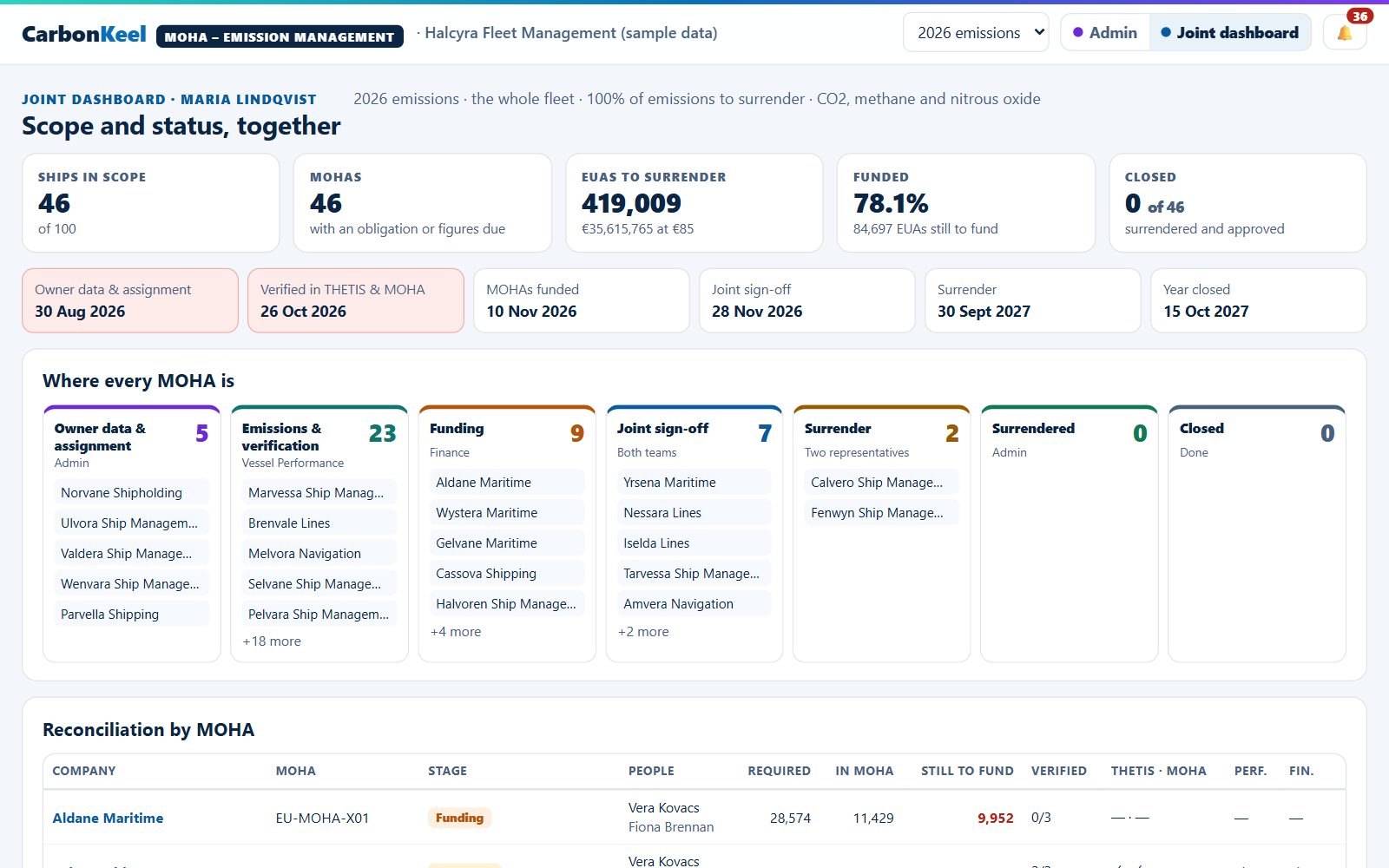
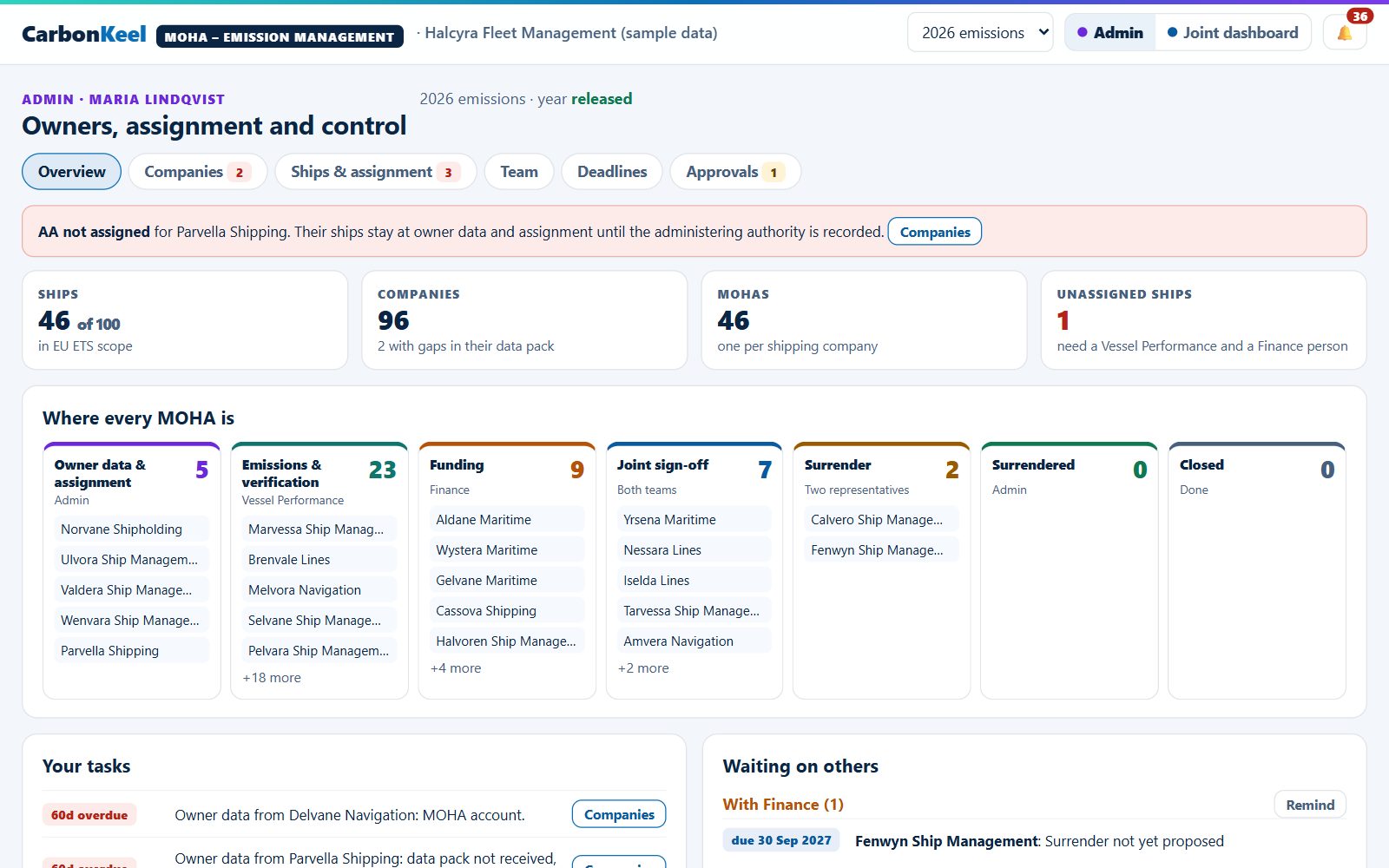
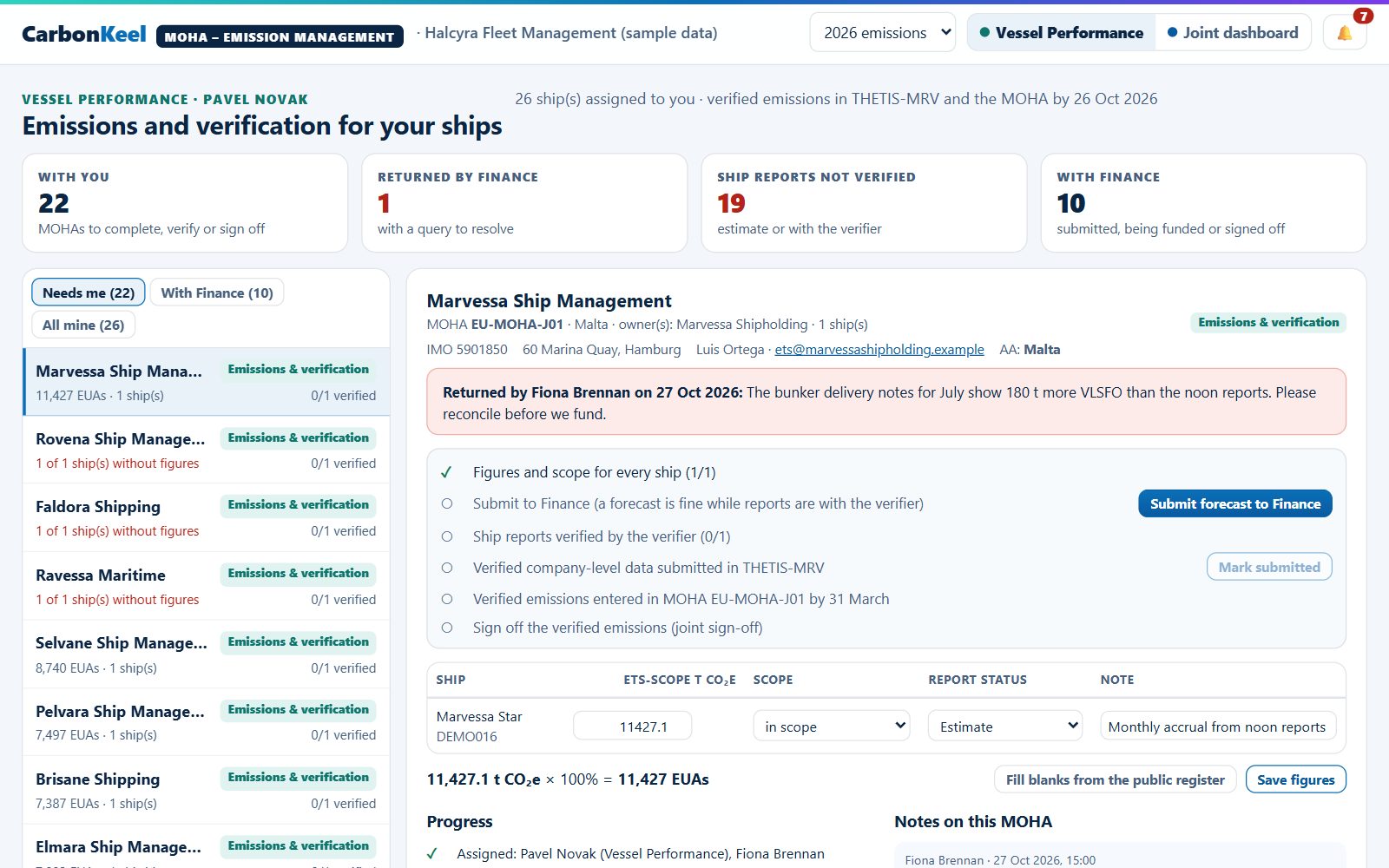
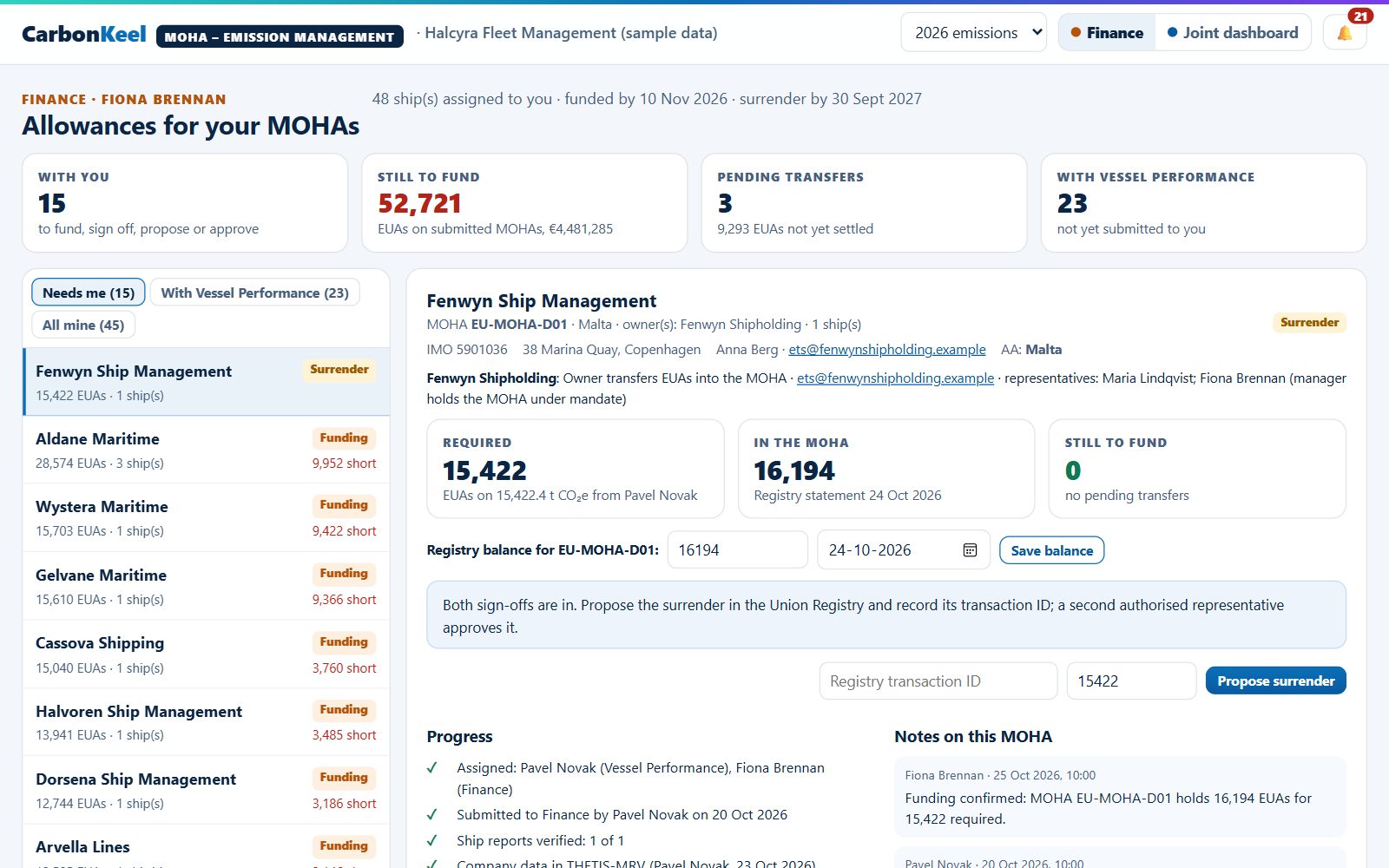
Made-up companies and ships. MOHA is the Maritime Operator Holding Account each shipping company holds for its EU allowances.
Every message is read and answered by email, usually within one working day.
Give us your IMO numbers and we will come back with the whole fleet costed. If you would rather ask a question first, that is fine too.
Sent to us and kept as the privacy notice says. Or write to enquiry@carbonkeel.com.
Every rule a ship trading into Europe pays for, with the formula and a calculator to try.
Start with one ship: in ten seconds you will know whether anything here is worth your time.
Your message
Where to reply
Sent to us and kept as the privacy notice says.